COMMENTARY:
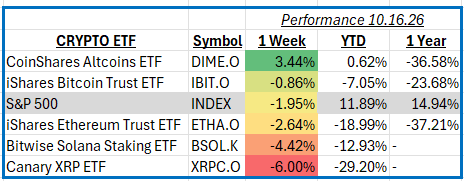
The S&P 500 declined 1.95% for the week ending October 16, as technology-sector weakness, persistent inflation, and uncertainty surrounding Federal Reserve policy pressured risk assets. Cryptocurrency markets also faced headwinds from institutional investment outflows, with approximately $594 million withdrawn from U.S. spot cryptocurrency exchange-traded products during the week. Bitcoin briefly fell below $80,000 before recovering, while investors reassessed valuations and liquidity conditions. The combination of macroeconomic uncertainty, reduced institutional demand, and declining risk appetite contributed to uneven performance across digital assets.
Bitcoin: Bitcoin-related investments declined 0.86%, outperforming the S&P 500 by 1.09 percentage points and demonstrating relative resilience compared with other major cryptocurrencies. Bitcoin traded within an approximately $80,000–$84,000 range as investors responded to inflation data, interest-rate expectations, and institutional fund flows. Spot Bitcoin investment products experienced substantial weekly redemptions, indicating that institutional demand remained uncertain despite Bitcoin’s recovery from its weekly lows. Bitcoin’s comparatively modest decline reinforced its position as a more established digital asset during a challenging week for cryptocurrency investors.
Altcoins and Diversified Cryptocurrency Exposure: Diversified alternative cryptocurrency exposure gained 3.44%, making it the week’s strongest-performing category and outperforming the S&P 500 by 5.39 percentage points. While major cryptocurrencies generally weakened, individual digital assets experienced different price movements as investors rotated among blockchain networks and specialized applications. Selective interest in emerging blockchain projects, decentralized finance, and digital infrastructure helped distinguish certain alternative assets from the broader market downturn. However, diversified cryptocurrency exposure remains subject to substantial volatility, liquidity constraints, and differences in underlying asset adoption.
Ethereum: Ethereum-related investments declined 2.64%, underperforming the S&P 500 by 0.69 percentage points. Ethereum faced particularly pronounced institutional selling, with spot investment products experiencing approximately $320 million in net weekly outflows across the category. Ether traded near $2,450 toward the end of the week after testing lower levels. Investor concerns about capital flows and competition among blockchain networks continued to influence sentiment, despite Ethereum’s established role in decentralized finance, smart contracts, and tokenization.
Solana and XRP: Solana-related investments fell 4.42%, while XRP-related investments declined 6.00%, making XRP the weakest-performing category among the five exposures. XRP underperformed the S&P 500 by 4.05 percentage points, the largest negative relative performance difference. Solana experienced continued investment-product outflows, while XRP-related trading reflected broader volatility across alternative cryptocurrencies. Both assets remain sensitive to network adoption, regulatory developments, liquidity, and investor appetite for higher-risk digital assets.
Overall, diversified alternative cryptocurrencies led performance, while XRP and Solana lagged. Institutional flows, inflation, and Federal Reserve expectations remain important market drivers. Investors should recognize the substantial volatility and risks associated with digital assets.